
RSS is a powerful advance in Internet technology. It’s a game changer. Yet, RSS is also one of the most underutilized Internet technologies. If you feel like the Internet is taking over and you just don’t know how to catch up, RSS can help. And, if you don’t feel that way you should look behind you; there’s a rising tidal wave of Internet marketing that is threatening to capsize the traditional marketing boat. It’s time to start bailing out that water rising around your ankles, and RSS is the best place to start.
How often do you hear a phrase like, “Go to www.suchandsuch.com?” “Going to” a website- the idea makes sense right? Not for much longer. It wasn’t that long ago that I used to rely upon bookmarks in my browser to remind me of all the different websites that I like to keep up with. I had them all nicely categorized so that I could look under “Project Management,” say, find the entry for Max Wideman’s Project Management Glossary, then go there to see what’s new. Now, most of the sites I keep up with provide RSS feeds for their frequently updated content, so as a subscriber, their information comes to me. That means for many of these sites, I no longer need the bookmark to remind me that I’m interested in their content (not to mention the fact that del.icio.us allows me to access bookmarks from any computer, anywhere).
In this newsletter, I’ll re-introduce you to RSS and a new side of the internet where information is no longer tied to websites. I’ll try not to get too wildly visionary, but because I agree with Eric that RSS has become one of the most important technologies used on the internet, my hunch is that the day is coming when even the word “website” might be a bit of an anachronism.
What is RSS?
RSS stands for Really Simple Syndication and is used to refer to an XML file that enables content from a website to be simultaneously published to anyone that has subscribed to it. Using an RSS feed reader, or aggregator, you can subscribe to RSS feeds from any source and view the content immediately after it has been published. In other words, RSS enables you to receive information from multiple websites directly to one place without having to go to those websites individually.
Keeping Up by Skimming
Besides changing how information is communicated online, RSS is changing the rate by which information flows, and no, that doesn’t mean less- it means more. Much more. Thankfully, there are great tools being created that will help you to manage this increase without losing your mind. But more than just adopting new tools, we’re going to have to adapt and learn some new skills to filter and organize all this content.
The most important skill is learning how to skim. Once you start subscribing to RSS feeds, you will have more information available to you then you ever imagined. Because there is so much, it’s likely that much of it won’t be relevant to you. Unfortunately, you won’t know one way or another unless you start sifting through it. Good skimming means that you can quickly scan content and determine if it is relevant to you. Then, you can either decide to read it more closely, file it away for future reference, or maybe even share it with a friend. Since information is going to keep coming, you’re either going to “sink or skim.”
As you’re getting the hang of skimming through the articles you receive, you should be actively adding new subscriptions as well. There will definitely be a limit to how many you can handle, but if you’re skimming helps you to evaluate whether an article is relevant to you, you’ll probably find that your subscription list will fluctuate. I’ve found that my overall list tends to top off at around 110 subscriptions. That may seem like a huge number, but only a portion of those subscriptions are actively delivering content to my reader. Some subscriptions update as often as 15 or more times a day, while others may update on an average of once or even less. When one of my subscriptions updates very often but rarely with information that is relevant to me, I’ll unsubscribe. After all, at that point, the feed is more or less spam to me. That’s one of the benefits of RSS over email, with RSS you always control the intake of your reader, while with email you’re at the mercy of the undependable unsubscribe function. Learning when to unsubscribe is a critical skill that will help you keep your head above the RSS water.
One last point about skimming: Some people who value reading will probably be initially disturbed by the notion of skimming as a means of staying informed, especially when it comes to content that is professionally relevant.
Some Google Reader Strategies
Tagging
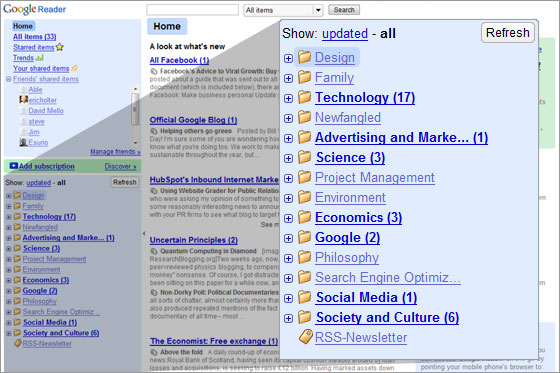
The first strategy that will make using Reader a beneficial experience for you is using tags to organize your subscriptions. My approach is to start by grouping and categorizing my subscriptions so that I can read through the latest feeds I’ve received within a common context. For example, I have about 24 subscriptions that are all tagged as “technology.” These include various blogs that report on subjects like new software and hardware, the ethics of technology, tech R&D, and some company-specific news. But because many of these feeds may deliver the same stories to my Reader account, viewing them in chronological order and grouped by tag helps me to skim through them faster and isolate one article to represent a story reported by many subscriptions. I use about 14 different tags to categorize all my subscriptions and have little bleed from one category to another. When you use tags in this way, they will appear like folders ( ) that organize your subscription list on the left side of your Reader account screen. You can actually drag and drop subscriptions from one folder to another to re-categorize them. However, you can also assign a tag to individual articles rather than to entire subscriptions. You might find this method helpful for researching purposes or just for when a particular article merits its own unique tag. When you use a tag in this way, it will appear with a “tag” icon (  ) at the bottom of your subscription list.
Shortcuts
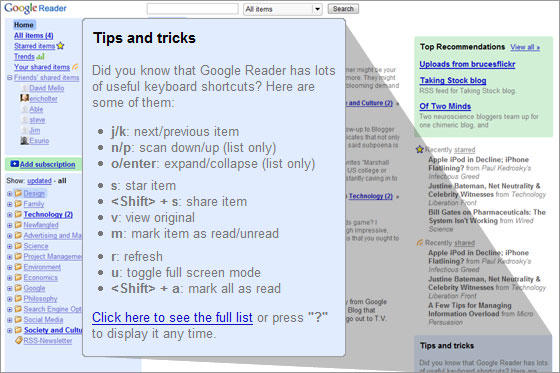
I also prefer to go through my subscriptions using the expanded view, rather than the list view. The expanded view lets me see the entire article so that I can skim through it, rather than using just the title and a snippet to decide if I want to read it, discard it, or share it with a friend. Using the Reader keyboard shortcuts is really helpful here; you can hit “j” or “k” to skip to the next or previous articles rather than having to scroll using your mouse, “m” to mark an article as “read,” or “shift + m” to mark all articles as “read.” I’ve never been a strong user of keyboard shortcuts until I started using Reader and realized just how much time using them actually saved! Believe me when I say that the more subscriptions you have, the more important it will be to you to use time-saving methods like keyboard shortcuts.
Starring
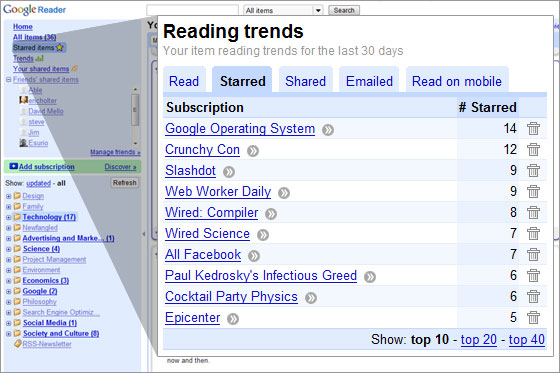
Starring is a Google favorite. If you use Gmail, you’ve probably starred (  ) an email before- for a variety of different reasons. The neat thing about starring is that it’s a feature that you can use for whatever purpose you choose, though it’s probably best suited for drawing attention to something, as if to say, “this is important,” or “follow up on this.” Eric and I decided to start using the star in Reader to indicate articles that we read in full after we realized that Reader really has no way to distinguish between whether you skimmed an article or actually read it. As long as you scroll through an article and reach the next one, Reader will mark it as “read,” even though you may not have actually read a single word. By starring the articles I actually read thoroughly, I can look at a list of my starred items in the Reader trends view (more on trends on the next page) to see which subscriptions are most important to me overall.
Sharing RSS Feeds
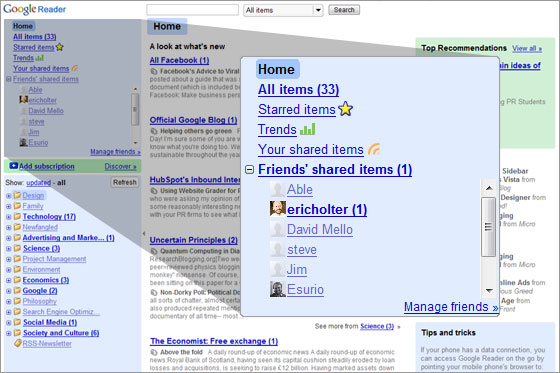
Aside from its great interface and ease of use, Reader’s killer feature is sharing (  ) . Sharing introduces a social aspect to Reader by allowing you to individually share articles with anyone via email, as well as tag any article to be shared with your existing Google contacts who use Reader. You’ll be able to see these “friends” by looking at the top left of your Reader main page, under the heading “Friends shared items.” You can view all of your friends’ shared articles in chronological order, or you can click an individual friend’s name and view only those articles he or she has shared.
By exploring your friends’ shared articles, you’ll likely discover new feeds that you’ll want to subscribe to, which could be initially much more helpful than Readers “Top Recommendations” since you likely have more in common with your friends than an algorithm can replicate. Case in point: I recently found a blog kept by Jeremiah Owyang, a web strategist at Forrester Research, after it was referenced in an article I was reading. I checked it out and subscribed to his feed right away. Afterward, I instant messaged Eric, “have you heard of this guy?,” to which he replied, “Yeah, I’ve been sharing posts of his in Reader for a while now.” Needless to say, I’ve learned to trust my friends recommendations and pay attention to the social features in Reader.
Google Reader Trends
While I think that sharing is Reader’s killer feature, the trends view (  ) is my favorite feature. The trends view is like a mini-analytics application just for your account and provides an overview of how you use Reader, including how many subscriptions you have, how many items you’ve read, shared, starred or emailed, how often your subscriptions update, when you tend to use Reader, and which of your tags have the most activity. The importance of this tool brings me back to the overall strategy that you need to have in order to just keep up with the momentum of RSS, which is to be constantly evaluating the information that comes to you. While I’ve spent most of this newsletter discussing how to do this on an article to article basis by skimming to evaluate whether to read it or move on, it’s also important to do on a larger scale by measuring the overall value of a subscription.
Over time, it’s likely that you’ll find reasons to unsubscribe to an RSS feed. Perhaps you’ll find another subscription covering the same kind of information as an existing one, but with a level of activity that suits you better. Or, you may even lose interest in a subscription. Some subscriptions may only run for a specific time period. Using trends, you can see exactly how often a particular subscription delivers new articles to you, and how often you actually read rather than skimmed them (especially if you star those articles which you’ve actually read). I’ve unsubscribed to several RSS feeds after looking at trends from these different perspectives, which keeps my total number at a manageable level.
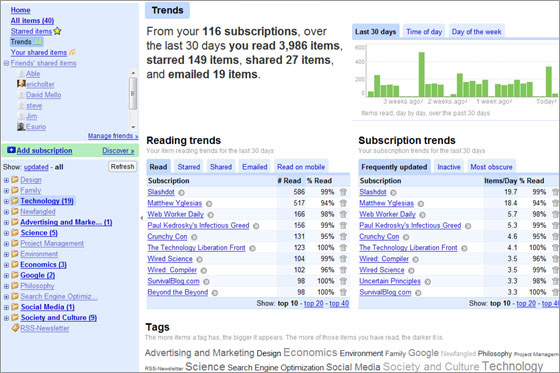
You’ll likely find many other ways to use the information from trends to evaluate your use of Reader and make small adjustments that suit your lifestyle and subscriptions best, including measuring the appropriateness of tags based upon your subscriptions’ content and activity and even planning a time in your day to use Reader based upon when you tend to read you subscriptions. Overall, I think that the value of the trends will correspond to how much you experiment with RSS initially and continue to evaluate your subscriptions over time.
You Can Do It!
As you can probably tell, keeping up with RSS is going to be more than a hobby. In this industry, it’s a necessity that you begin to understand and use it as soon as possible. I mentioned finding a good time in your day to do this in passing above, but I want to expand on that point briefly as an encouragement to those who might be overwhelmed at just the idea of the “rising tidal wave” that is RSS. I’m a morning person, so I tend to do the majority of my reading (and skimming) early in the day before my phone starts ringing and my email inbox filling up. However, I’m also fairly used to quickly checking in on my Reader account multiple times throughout the day. These quicker check-ins allow me to stay ahead of the curve and file away new articles or mark others to read later (using the “mark as read” feature is helpful here). This is the schedule that suits me best and enables me to keep up with the number of subscriptions I have. Likewise, you’ll need to find a routine that suits your schedule best. Ultimately, one time of day is not necessarily better than another as feeds are being updated on a 24-hour basis- it just needs to be sometime each day. Otherwise, you’ll end up spending a much larger amount of time trying to catch up on several days worth of information in one sitting.
Though this all may seem very daunting, it’s also going to be fun. The internet was created out of a desire to enable communication, and RSS has truly raised the bar in that regard. If you desire to learn and want to take advantage of all the information available to you, RSS will enable you to do so with the greatest ease and flexibility the internet has to offer at the moment. I have no doubt that there will be advances in the future that make this even easier and more flexible… but chances are you’ll find out about it via RSS.
Related Posts
-

Christopher Butler will be a keynote speaker at the 2015 ConvergeSE conference...
-


Chris Butler will be speaking at the concluding session of the AIGA's Web101 course...
-
Chris Butler is MC'ing at this year's Hopscotch Design Festival...